The History Animation
Animation is a sequence of still images that are presented in a way that it looks as if they are moving. It started in the early 1800s as parlour-game toys, which experimented with persistence of vision. Persistence of vision is when the eyes perceive an object and the brain continues for a small fraction of a second after the view blocked or the object is removed.
Early animation devices
- Thaumatrope (1824) Dr John Paris
A Thaumatrope is a simple toy that was popular in the 19th century. It is a small disk with different pictures on each side, such as a bird and a cage, and is attached to two pieces of string. When the strings are twirled quickly between the fingers, the pictures appear to combine into a single image. Thaumatrope were one of a number of simple, mechanical optical toys that use persistence of vision. A Thaumatrope could only take two images and merge them, essentially creating one still image from two.

- Phenakistoscope (1832) Joseph Plateau
The Phenakistoscope was a great improvement on the Thaumatrope, creating on moving image from several stills, and became the first optical toy to create a true illusion of motion. This toy had a disc with s sequences of images set in a ring around the circumference. When the disc was spun, the drawings were viewed through small slits cut into the disc. Which provided the visual interruptions needed for the eye to meld the images together thus creating the impression of motion. The Phenakistoscope disc is mounted on a spindle and a mirror was used to reflect the images. It was quite successful for two years until William George Horner invented the zoetrope.

- Zoetrope (1834) William Horner

Praxinoscope (1877) Charles Emile Reynaud
The Praxinoscope was similar to the zoetrope but refined to use reflected light. This was the device to overcome the blurred distortion caused by viewing through narrow fast moving slots. It used paper strips of pictures placed inside a shallow outer cylinder, so that each picture is reflected by the inner set of mirror. The number of mirrors equals the number of images on the paper strip. When the outer cylinder rotates, the quick succession of images reflected in the mirrors give the illusion of movement. This produced an image that was sharper than any other pervious device.

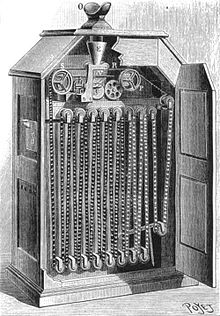
- Kinetoscope (1891) Thomas A Edison and William Dickson

- Mutoscope (1894) Winsor McCay

